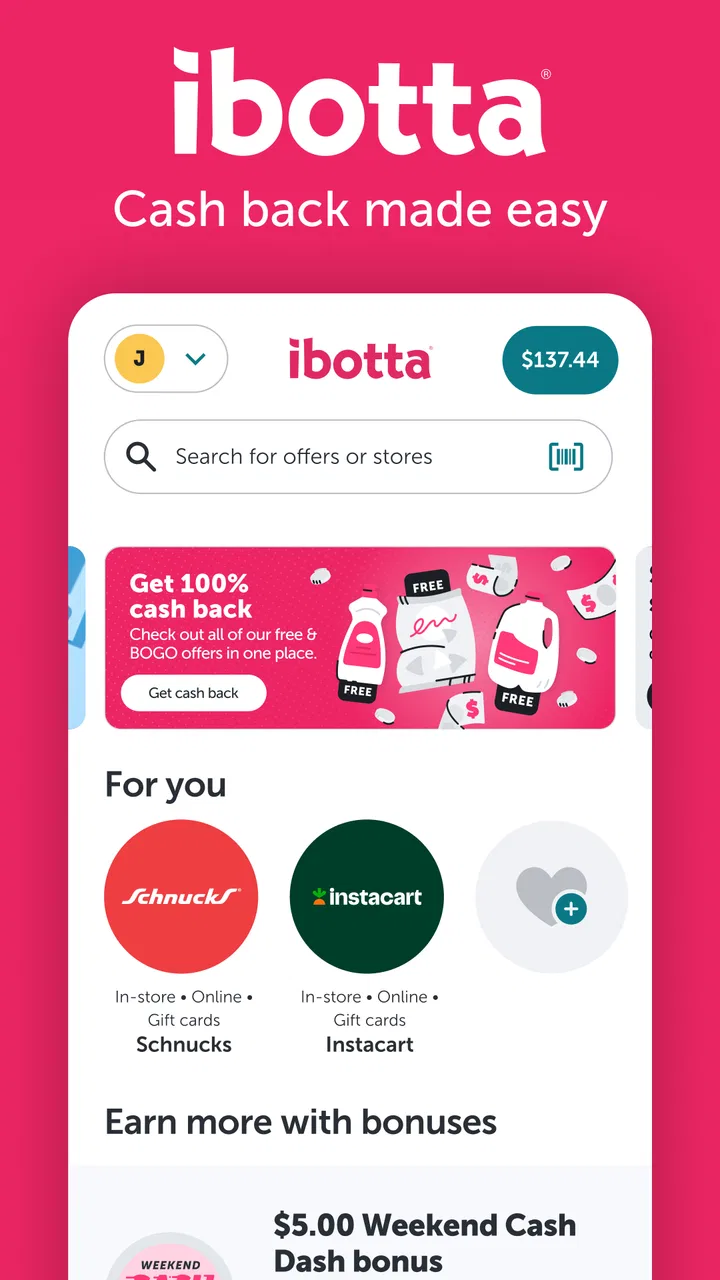
Ibotta: Save & Earn Cash Back
- 4.5
- Rating
- 10.00M
- Installs
- Free
- Price

 Analysis by App-foxy
Ibotta is the kind of shopping app that rewards a little planning rather than demanding a complete change in the way I buy things. I use it as a checkpoint before a grocery run, a way to look for cash-back opportunities on purchases I was already considering, and a reminder to keep receipts or follow the required purchase steps. My overall view is positive: it can turn ordinary shopping into a small source of savings, but it works best when I treat the offers as a bonus instead of a reason to spend more.
That distinction matters. Cash-back apps can easily encourage impulse buying, especially when an offer makes an unnecessary product look like a bargain. With Ibotta, I get the most value when I begin with my shopping list, check which items fit it, and ignore everything else. The app is strongest as a planning tool, not as a license to buy whatever appears on screen.
How the shopping experience feels in everyday use
At its core, this is a free shopping app from Ibotta, designed for people who want cash back on eligible purchases. The basic routine is straightforward: open the app before shopping, browse available offers, select the ones that match what I need, and complete the purchase in the way the offer requires. Depending on the offer, that may involve shopping through the app, linking the activity to a participating retailer, or submitting proof of purchase. The important habit is to read each offer carefully before paying rather than assuming every promotion works automatically.
You May Also Like

 Pandora - Music & Podcasts
Pandora’s Music Is Easy to Start, but Harder to Recover
Pandora’s strength is its low-effort path from a seed to a station. Its weak spot is how much confidence it asks you to place in connection, setup, and quiet recovery.

 8 Ball Pool
 Is Built on Rivalries, Rematches, and Routine
A close look at the rivalries, rematches, shared routines, and unanswered safety questions that turn a quick pool match into a persistent mobile community.

 Samsung Music
’s Quiet Strength Is Playing What You Already Own
Its reach comes less from spectacle than from dependable access to a personal library. That simplicity is both the app’s strongest retention engine and its ceiling.

 AccuWeather: Weather Radar
AccuWeather Review: A Quick, Clear Forecast for Everyday Decisions
For everyday plans, the best forecast is the one you can understand quickly. AccuWeather makes rain timing, radar, and local conditions easy to act on, with a few trade-offs.

 Hill Climb Racing
Why Hill Climb Racing Still Turns Crashes Into One More Run
A tiny car, a bumpy hill and one more upgrade: Hill Climb Racing keeps resurfacing because its simple chaos makes every near-miss feel personal.

 AliExpress - Shopping App
AliExpress Makes Global Shopping Feel Personal, but Shoppers Bear the Risk
AliExpress turns a global marketplace into a pocket-sized discovery engine. Its reach is useful, its shopping loop compelling, and its trade-offs easy to miss.
More From Our News Desk
View All News


I found the preparation stage more important than the browsing stage. If I open the app without a plan, the list of possible deals can become a distraction. If I open it with a grocery list already written, I can quickly decide whether an offer applies to something I would buy anyway. That small change makes the experience feel practical instead of promotional. It also protects the real value of the cash back, because a discount is not a saving when it leads to an unnecessary purchase.
A realistic example is a weekly grocery trip. Before leaving home, I check the current offers and look for products already on my list. I select the relevant items, take note of any brand, size, quantity, or purchase conditions, and then shop normally. Afterward, I follow the required confirmation process rather than throwing away the receipt immediately. This workflow is not difficult, but it does require attention. A rushed user may forget to activate an offer, choose a product that does not qualify, or miss a submission step.
That is one of the app’s less obvious lessons: the best savings come from matching the app to an existing routine. I would not build my entire shopping trip around the offers. I would use the offers to refine a trip I was already going to make. This approach also makes it easier to compare the final price with the usual alternative, such as a store loyalty program, a paper coupon, or a retailer’s own promotion.
Where it delivers the most useful value
The biggest strength is convenience across ordinary shopping decisions. Instead of searching through printed coupons or checking several retailer pages separately, I can use one place to see whether a purchase may qualify for cash back. That does not guarantee that every item I want will have an offer, but it reduces the effort involved in checking. For busy shoppers, the time saved during preparation can be nearly as important as the reward itself.
I also like the way the app can change how I compare similar products. If two acceptable options are already on my list, an eligible cash-back offer may make one the better choice. I still consider the shelf price, package size, and whether I actually prefer the product. Cash back is only one part of the calculation. In practice, the app is most useful when it helps me choose between reasonable alternatives rather than pushing me toward a completely different purchase.
Another practical strength is that the app can support different shopping styles. Someone who buys groceries in person may use it around a weekly trip, while someone who prefers online shopping may look for offers connected to eligible digital purchases. The exact process depends on the individual offer, so I would not assume that a method that works for one product applies to another. Reading the instructions is part of using the app properly, not an optional extra.
The audience size also gives me some confidence that this is not an obscure experiment. It has a 4.6 average from around 714 thousand ratings, and the app has passed 10 million installs. Those figures do not prove that every user will have the same experience, but they show that the service has attracted a substantial audience. I see that as useful context when deciding whether it is worth trying, especially because the app itself is free.
The details I check before I buy
I pay close attention to eligibility wording. A product may look similar to the one in an offer while still differing by brand, flavor, size, or package format. I also check whether the offer requires a certain quantity or a particular purchase route. These details are easy to overlook when I am standing in a busy store, so I prefer to review them at home and save a screenshot or mental note of what I need to verify. I do not rely on memory when several similar products are on the shelf.
Receipt handling is another part of the workflow that deserves more attention than it usually gets. If a purchase needs proof, I keep the receipt in good condition and submit it promptly. I also make sure the image is readable and that the relevant items are visible. This is a small operational habit, but it prevents a potentially valid purchase from becoming frustrating simply because the evidence is unclear or unavailable.
For online purchases, I take a different approach. I begin inside the app and follow the offer’s route rather than starting somewhere else and hoping the transaction will be recognized afterward. That is a useful distinction from ordinary coupon hunting. A paper coupon can often be handed over at checkout, while a digital cash-back offer may depend on how the shopping session begins or how the purchase is recorded. The app is therefore better suited to deliberate shoppers than to people who want to remember everything at the register.
I also compare the net result with the alternatives. A store loyalty discount may reduce the price immediately, while Ibotta may provide cash back later through its own process. A manufacturer coupon may offer a larger reduction on a particular item, while an app offer may be easier to find. Neither option is automatically better. My preferred routine is to check the store’s normal promotion first, then see whether the app adds value without changing the purchase I intended to make.
The meaningful friction behind the savings
The main weakness is that the reward is not completely passive. I have to remember to check offers, activate or select the right ones when required, buy the qualifying item, and complete any confirmation step. That chain creates several opportunities for mistakes. A user who wants to scan once and forget about the process may find the experience less satisfying than a simple instant discount at checkout.
Offer availability can also shape the experience. Cash-back opportunities are not necessarily useful just because they exist. They may apply to products I do not need, brands I would not normally choose, or purchases that are only attractive after a larger amount of spending. I would be cautious about treating the offer feed as a shopping list. The app can help me save on a planned purchase, but it cannot guarantee that my preferred product or store will always be included.
There is also a psychological trade-off. Seeing a reward attached to an item can make a purchase feel more economical than it really is. I have to calculate the final cost, not just focus on the cash-back amount. If the promoted product costs substantially more than my usual choice, the reward may not compensate for the difference. This is where a basic note on my phone or a quick comparison on the shelf becomes valuable.
The app’s current version is 6.325.0, and it supports devices running Android 8.0 or later. For someone using an older phone, compatibility should be checked before planning around the service. On supported devices, I would still keep the app updated when possible, because shopping tools depend on current offer information and reliable transaction handling. I would not want to discover an issue at the checkout after spending time preparing a purchase.
Some shoppers may also dislike the general idea of managing another shopping account and another rewards process. That is a legitimate objection. If I already have a retailer loyalty program that covers nearly everything I buy and applies discounts instantly, adding Ibotta may not be worth the extra attention. The app makes more sense when it fills gaps in an existing routine rather than duplicating a system that already works well.
Who should use it, and who should skip it
I think Ibotta is a good fit for organized grocery shoppers, families trying to reduce recurring household costs, and people who are comfortable checking an app before they buy. It is especially useful for someone who can keep receipts, follow offer conditions, and wait for the cash-back process instead of needing the discount to appear immediately. The free price also makes experimenting relatively low-risk, provided the user avoids spending merely to chase rewards.
It can also suit a shopper who buys from several retailers and wants one place to review possible savings. I would use it as a comparison layer: first decide what I need, then check whether the app offers a better route for that purchase. That workflow is more reliable than browsing the app for inspiration. It keeps my budget in control and turns the service into a practical assistant rather than a source of temptation.
I would skip it if I rarely shop, dislike keeping receipts, or find promotional conditions irritating. I would also avoid making it central to my routine if I need guaranteed savings at the register. In that case, a store’s own loyalty pricing or a straightforward coupon may be better because the benefit is visible immediately and requires fewer follow-up steps. Likewise, people who are highly brand-loyal may find that many available offers do not match their normal choices.
The age rating is Everyone, which fits the app’s general shopping purpose. Still, the fact that it is accessible to a broad audience does not mean every household should use it in the same way. Parents, students, and anyone managing a strict budget should set a simple rule: only pursue an offer when the item was already planned or clearly replaces a more expensive equivalent. That rule does more to protect savings than collecting every available promotion.
How I would build a reliable routine
I would begin by checking the app once before a shopping trip rather than repeatedly throughout the day. I would create a short list of products I actually need, compare the qualifying requirements, and select only the offers that fit. This reduces decision fatigue and makes it less likely that I will forget which conditions apply. After shopping, I would review the receipt while the details are still fresh and complete the required submission before putting the groceries away.
For recurring purchases, I would track the final cost over several trips instead of judging the app from one unusually good offer. That reveals whether the service genuinely changes my spending or merely adds occasional small rewards. It also helps me notice when a store promotion, a generic alternative, or a different brand is the better deal. The app should support that comparison, not replace it.
One advanced but simple tactic is to separate “planned offers” from “interesting offers.” Planned offers are connected to items already on my list and deserve attention. Interesting offers are products I might consider but do not need. I would ignore the second group unless the product is a genuine substitute for something I was going to buy. This distinction keeps the reward system from quietly expanding my basket.
I would also avoid assuming that a successful past claim guarantees the same process next time. Offers can have their own conditions, and shopping methods can differ. Before every meaningful purchase, I would read the current instructions again. That may sound repetitive, but it is faster than correcting a mistake after checkout and is particularly important when buying similar products in different sizes or quantities.
My final view after weighing convenience against effort
Ibotta is worth trying when you want flexible cash back and are willing to do a little preparation. I like that it can fit around normal shopping rather than requiring me to become a dedicated coupon collector. Its strongest role is helping me identify savings on purchases I already planned, then giving me a structured way to claim them. The free cost lowers the barrier to testing that routine, and the broad user base suggests that many shoppers find the model worthwhile.
My reservations are equally clear. The app does not make every purchase cheaper, it does not remove the need to read conditions, and it is not automatically better than an instant store discount. The reward can also encourage unnecessary spending if I stop comparing the final price. For that reason, I would recommend using it with a shopping list, a receipt habit, and a willingness to walk away from an offer that does not fit the budget.
Developed by Ibotta and available as a shopping app rather than a traditional coupon booklet, it is best viewed as a useful layer between planning and checkout. I would recommend it to practical shoppers who enjoy finding small efficiencies and can tolerate a few extra steps. I would not recommend it to someone seeking completely automatic savings or a guaranteed discount on every trip. Used selectively, Ibotta can make routine purchases feel a little more rewarding without taking over the way I shop.
FAQs for Ibotta: Save & Earn Cash Back
01What is Ibotta and how does it work?
Ibotta is a mobile app that allows users to earn cash back on everyday purchases, both online and in-store. Users can browse offers, complete tasks such as watching short videos or answering questions, and then shop at participating retailers. After purchasing, users simply upload their receipt or link their loyalty accounts to receive cash back.
02Is Ibotta safe and secure to use?
Yes, Ibotta is safe and secure. The app uses encryption to protect user data and does not sell personal information to third parties. Additionally, Ibotta partners with trusted retailers and brands, ensuring that transactions and cash back rewards are processed securely.
03How can I maximize my earnings with Ibotta?
To maximize earnings with Ibotta, regularly check the app for new offers and bonuses. Link your loyalty accounts for automatic cash back, and invite friends to join for referral bonuses. Combining Ibotta offers with coupons and sales can also increase your savings significantly.
04What are the requirements to cash out earnings from Ibotta?
To cash out earnings, users must have a minimum balance of $20. Ibotta offers several cash-out options, including PayPal, Venmo, and gift cards to popular retailers. Ensure your account is verified to prevent any delays in receiving your funds.
05Are there any fees associated with using Ibotta?
Ibotta is free to download and use, with no hidden fees. However, if your account remains inactive for 12 consecutive months, Ibotta may deduct a small maintenance fee from your balance. To avoid this, regularly use the app to keep your account active.
Pros
- Easy to use interface for quick navigation.
- Wide range of participating retailers.
- Offers cash back on everyday purchases.
- Frequent updates with new deals and offers.
- In-app tutorials for new users.
Cons
- Requires linking bank account for cash out.
- Some offers have strict redemption criteria.
- Limited support for international users.
- Occasional app crashes reported.
- Not all purchases qualify for cash back.

Ibotta: Save & Earn Cash Back
Gallery